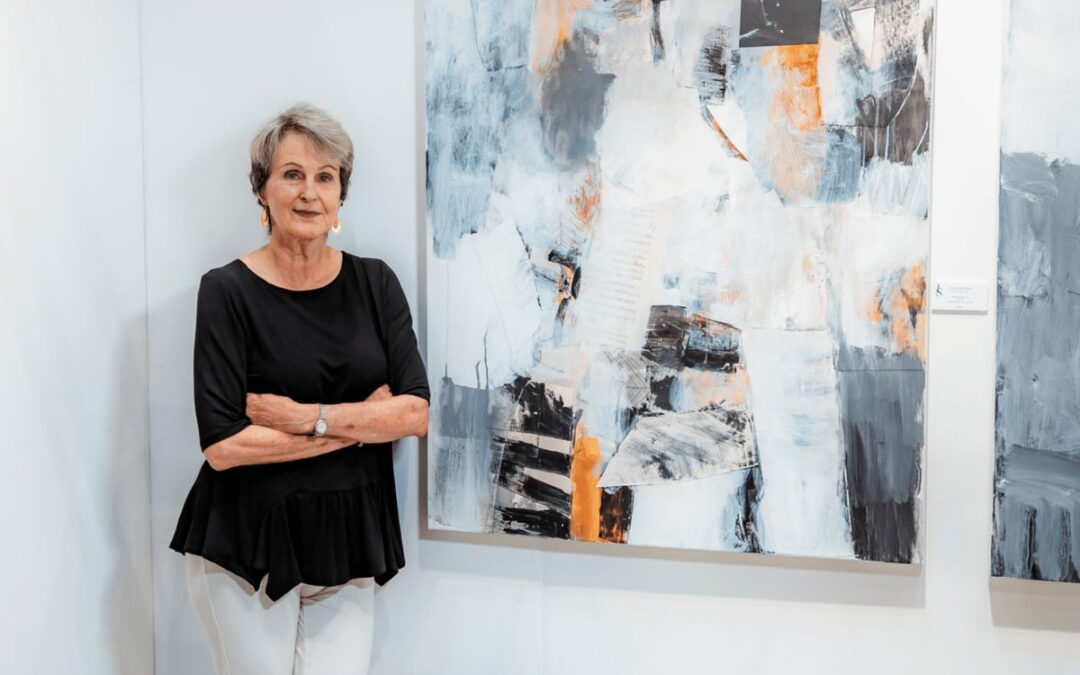
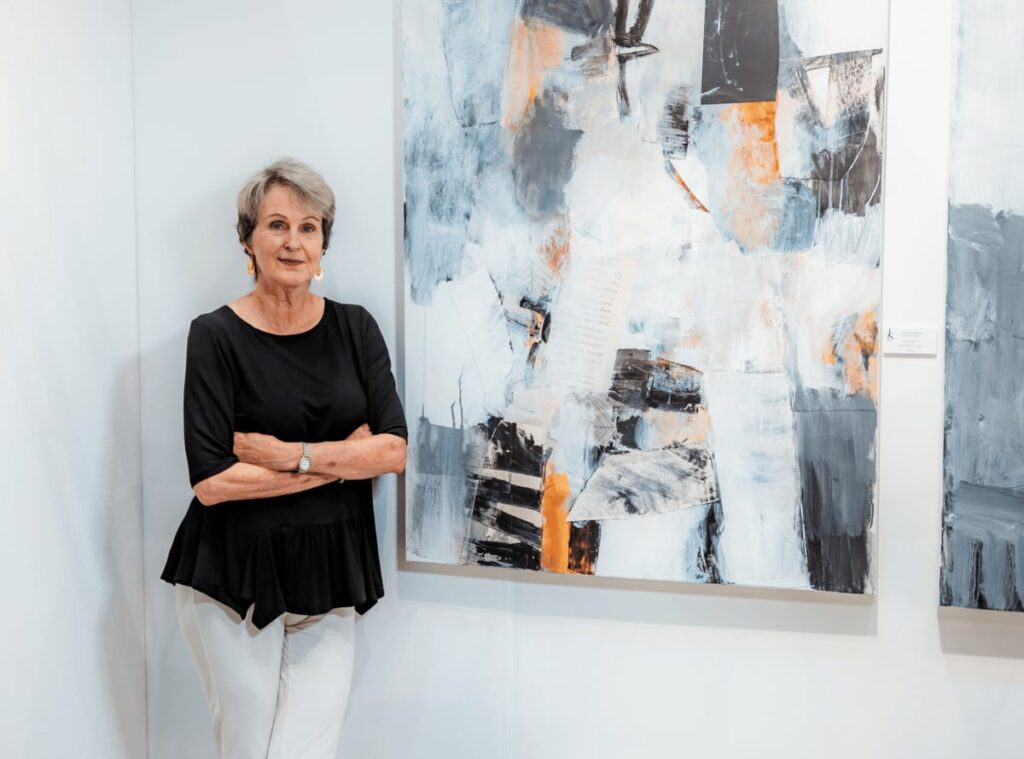
Member artist Julie Schumer shown with her work in a gallery.
NMC Co-Chair Tracy King here — as an artist and a gallery owner I want to share insights I gathered regarding gallery representation from my personal experience, conversations with the Turner Carroll Gallery Director Jeffery Kuiper, and the excellent online class “Gallery Ready: A Step by Step Guide to Representation and Success” offered by NMC artist member Julie Schumer.
Though many gallerists prefer to find their own artists, there is a lot you can do to get you and your artwork noticed. In fact, through the professionalization of your art practice, taking control, managing your art career, and promoting your work, you may find it easy to attract a gallery. I hope that these tips and tricks will help YOU find gallery representation wherever you live.
Bookmark this post to keep these resources at hand!
1. Your Art
Define what your goals are as an artist.
Be true to who you are, follow your heart, and create in your authentic voice.
Determine your unique, artistic expression and create work that is uniquely yours.
Invest in your art practice/continuously build your artistic toolbox.
Be brave and push yourself to grow. Take risks & experiment!
Establish dedicated studio time and commit to it. “Inspiration is for amateurs, the rest of us just show up and get to work.” – Chuck Close
Build a trusted community of artists, or people in the art community, that can be counted on to provide helpful insights and or mentoring.
Even if you are a multi-disciplinary artist, it helps to have a focus on a single medium and create a body of work that is cohesive. Having 20-25 pieces is a good guide. Why? Because galleries often look for consistency and focus, they know who you are as an artist and what they are investing in.
Make sure your art is finished and presented in a high-quality standard – this includes images, framing, etc.
Invest in and maintain a well-designed and professional website that is consistent with your brand image/work, current, includes an artist statement, CV/bio, and is easy to navigate.
Cultivate being your own, honest, constructive critic.
Show only your best work — more is not better. People remember both your best and worst work.
Make sure you have a professional, inspiring artist statement & biography. They need to be short and succinct, with a variety of sentence structuring. Avoid starting every sentence with a personal pronoun. There are many online resources to help, and you can leverage AI to assist, but make sure you oversee the fine-tuning.
Be organized: Establish and maintain an organized inventory system with details of art and collector contacts.
Invest in professional marketing materials, including: business cards, thank you notes, postcards, and a certificate of authenticity.
Learn how to utilize/leverage social media strategically. Again, there are many online resources to help. Start by searching topics like “how does Instagram work”.
Develop a professional newsletter to send out to your followers/collectors.
2. Do Your Homework
Research Galleries that are relevant to your work, price, and have a complementary/similar aesthetic to your art.
Think about how your work would be a logical addition to their portfolio of artists (make sure you wouldn’t be redundant or too similar to the other artists they represent).
Consider the markets/locations in which you are interested in being represented.
Ask about the gallery’s reputation, including their history, their vision for the future, how they treat their artists, how they negotiate with collectors, how they promote their artists, museum connections, and how quickly they pay commissions.
Create a database of galleries that you can easily reference. You may want to create an A and B list of potential galleries and keep track of your notes on each so that you can be as strategic as possible in your pursuit.
Galleries typically require you not to show in another gallery in the same city or state, so it is key to be strategic about your gallery choices.
Whenever possible, it is best to visit galleries in person. Pay attention to their overall presentation, staff, marketing materials, website, and storage (so you understand how your work will be cared for).
When you find galleries you are interested in, which could be a good fit for you, sign up for their newsletters and attend events to get to know them better.
Consider applying for internships in galleries or part-time work in galleries so you can get an inside look at the business.
Bottom line, take time to know the art market so you comprehensively understand and the industry.
3. Approaching Galleries/Promoting Your Work
Ask each gallery their preferred process of submitting your work. This information is often posted on their websites and ranges from sending them an email to stating they are not accepting new artists. Whatever it is, make sure to respect and adhere to their requirements.
Generally speaking, dropping into a gallery without an introduction or a scheduled appointment is not preferred and can work against you.
If the gallery asks for a cover letter, it should consist of three short paragraphs: Introduction (purpose of your letter), Middle (story behind your art, how your art fits into their gallery, link to your website), and last (how they can follow up with you).
Respect their time and keep communications professional and short.
Be confident without being arrogant.
In all communications with a gallery, always be respectful, professional, and honest. When sending email correspondence, make sure that it is personally addressed and only sent to the gallery to which you are applying (never bcc).
Remember: first impressions are lasting impressions.
Make sure you have a complete understanding and respect for the gallery’s role: promoting their gallery and artists, selling art, and making a profit through the cultivation of collectors/clients. They are a business and have hard costs like building maintenance, utilities, payroll, insurance, marketing/promotion, and more to cover every month.
It is also essential that you, the artist, are responsive to the gallery’s needs/requests and understand that it only works if there is a professional and trusted relationship. The lines of communication must be open, timely, and effective.
Explore other ways to promote your work such as on-line galleries, art shows, studio tours, pop-up shows, social media, the US Dept. of State’s Art in Embassies program, and art organizations like the New Mexico State Committee of the National Women in the Arts and their online Artist Registry and the Santa Fe Gallery Association’s Artist Portal.
When you are represented by a gallery, make sure you understand and have a clearly spelled-out and agreed-upon representation agreement and/or contract. Read the fine print and discuss the details with the gallery so you understand what you are signing. If something is not a good fit, talk it through; they may agree to change it to suit your needs.
In summary, remember that you are worth the effort to have your work represented in a gallery. Whereas galleries are not the only way you can share your unique, artistic voice with the world, they offer great advantages to expand your audience, increase the value of your artwork, and help with career development.
Resources:
If you would like to learn more about professionalizing your art practice, check out our business member Julie Schumer at julieschumerwokshops.com. Julie offers excellent, affordable online courses as well as in-person painting workshops.
Here is Art Collecting’s comprehensive online guide to Santa Fe’s galleries and related resources.
Noteworthy online galleries include: Absolute Arts, Saatchi Art, Fine Art America, Zatista, Art Pal, Artfinder, Artful Home, Ideel Art, My Modern Met, Singulart, U Gallery, The Artling, Uncommon Goods, Redwood Art Group and Xanadu Gallery. Choose one or more galleries to approach!
Santa Fe Gallery Association (SFGA) “Artist Portal”
— Tracy King, Co-Chair
Thanks to our business members who assisted!